
🤖 Graphics - Compute Shaders with Groupshared Memory
This article discusses the implementation of compute shaders with groupshared memory in HypeHype, following the deprecation of WebGL2/GLES3. It highlights efficient LDS usage.
Key Points:
• HypeHype implemented compute shaders with groupshared memory.
• WebGL2/GLES3 was deprecated earlier this year.
• Efficient LDS usage is crucial for performance.
🔗 Resources:
• Efficient LDS Usage ↗ - Blog post on efficient LDS usage
🤖 AI - The Geometry of Refusal in LLMs
This article summarizes research on how Large Language Models (LLMs) handle refusal, introducing a gradient-based approach and representational independence to model this behavior.
Key Points:
• Gradient-based approach used to map the internal geometry of refusal in LLMs.
• Representational independence is a key component of the model.
• Research conducted by @guennemann's lab and @GoogleAI.
🔗 Resources:
• ICML Conference ↗ - Conference where the research was presented.
✨ Design - Solid Angle's Arnold Renderer Logo
This article discusses the change in logo design for Autodesk's Arnold renderer after Autodesk acquired Solid Angle. The original logo's design and its meaning to rendering professionals are highlighted.
Key Points:
• Autodesk's acquisition of Solid Angle resulted in a logo change for Arnold renderer.
• Original logo depicted a geometric solid angle, recognizable to rendering experts.
• New logo is considered a less distinctive "fancy A".
🔗 Resources:

Image

Image
💡 Research - Publication Guidelines and Corruption Concerns
This article outlines strict guidelines for publishing work, emphasizing the avoidance of collaboration with SFI due to alleged corruption.
Key Points:
• Avoid collaboration with SFI during the publication process.
• No SFI benefit allowed until corruption is fully resolved.
• These guidelines apply to any publication of the mentioned work.
🤖 AI - LLM Judgments vs. Human Judgments in Evaluation
This article discusses a paper comparing human and LLM judgments on the performance of oracle runs and LLM re-rankers.
Key Points:
• Oracle runs outperform LLM re-rankers under human judgment.
• LLM judgments show the opposite, favoring LLM re-rankers.
• LLMs demonstrate higher positivity bias than humans, except towards oracle runs.
🔗 Resources:

Image

Image
💡 Education - Challenges in Scaling LLM-Based Assessment
This article addresses the difficulties in implementing LLM-focused assessment methods in higher education, particularly for large classes.
Key Points:
• Traditional assessment methods like oral exams and interviews don't scale well.
• Challenges are significant for large introductory courses.
• Blue books are proposed as a more scalable solution.
🤖 Future Focus - Research and Advisory Directions
This article outlines the author's future research and advisory focus areas.
Key Points:
• Focus on emergence, computation, translation, and 21st-century science.
• Emphasis on whole-earth flourishing and civil liberties.
• Increased time dedicated to outdoor activities.
🔗 Resources:

Image

Image
🤖 Surveillance - Advanced Camera Lens Technology
This article discusses the state-of-the-art in surveillance camera technology, referencing a 2021 paper detailing advanced camera lens technology.
Key Points:
• Advanced camera lens technology, detailed in a 2021 paper, is already several years old.
• Further advancements are likely, potentially reaching nanoscale dimensions.
• High-resolution embedding possibilities are discussed.
🔗 Resources:

Image
🤖 Surveillance - Contact Lens Cameras
This article discusses the development and potential of contact lens cameras, citing reports from 2019 and mentioning involvement from companies like Google and Meta.
Key Points:
• Development of contact lens cameras reported around 2019.
• Google and Meta were reportedly involved in development.
• 3D printing of camera components is possible or will be soon.
🔗 Resources:

Image
• Original Tweet ↗ - Early reporting on contact lens cameras.
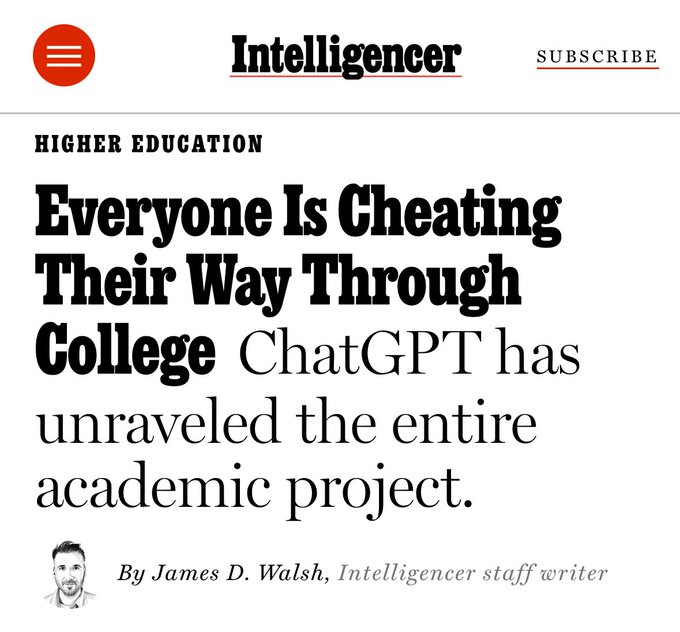
💡 Education - Higher Education in the Age of LLMs
This article explores the implications of advanced AI capabilities, such as ChatGPT, on the future of higher education and student literacy.
Key Points:
• Questions raised about the relevance of traditional literacy in the age of LLMs.
• Need for higher education adaptation to new technologies.
• The answer to the questions provided is a key to adaptation.
🔗 Resources:
Image
⭐️ Support
If you liked reading this report, please star ⭐️ this repository and follow me on Github ↗, 𝕏 (previously known as Twitter) ↗ to help others discover these resources and regular updates.
