
🤖 AI Models - Qwen3-Omni Multimodal AI
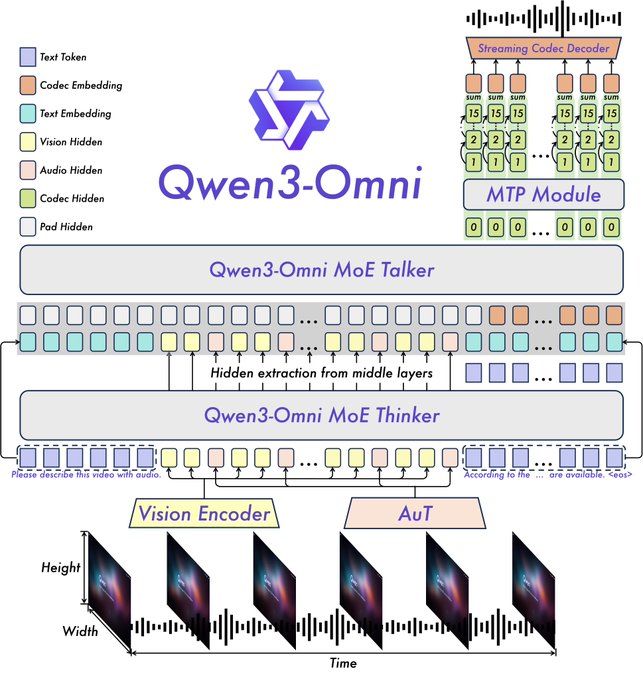
This article introduces Qwen3-Omni, a natively end-to-end omni-modal AI model. It unifies text, image, audio, and video processing without modality trade-offs. The model's performance and latency are also discussed.
Key Points:
• Unifies text, image, audio, and video processing in a single model.
• Achieves state-of-the-art results on numerous benchmarks.
• Offers low latency processing of various media types.
🔗 Resources:
• Stephen Fern ↗ - Qwen3-Omni creator
• Alibaba Qwen ↗ - Developer of the model
Image
🚀 Agent Environments and Evaluation - Gaia2 Benchmark
This article introduces Gaia2, an extensible benchmark for evaluating AI agents, and ARE, the platform where it's built. The goal is to reduce the simulation-to-reality gap in agent evaluation.
Key Points:
• Aims to reduce the simulation-to-reality gap in AI agent evaluation.
• Provides an extensible benchmark for evaluating various agents.
• Built on the ARE platform for scalability and ease of use.
🔗 Resources:
• May F1 ↗ - Involved in Gaia2 development
• Mialon Gregoire ↗ - Involved in Gaia2 development

Image
🤖 GPU Data Access - Triton's tl.make_block_ptr
This article explains how GPUs efficiently access data for computation, focusing on Triton's tl.make_block_ptr function. It covers tensor memory layout, make_block_ptr functionality (including striding and offset), and other relevant aspects of ML and Triton kernels.
Key Points:
• Explains how tensors are organized in GPU memory.
• Details the functionality of Triton's tl.make_block_ptr.
• Provides insights into efficient ML kernel development with Triton.
🔗 Resources:
• imAArora ↗ - Author of the blog post
• Nathancgy4 ↗ - Author of the blog post

Image
💡 Deep Learning Education - CS231n Course Revamp
This article discusses the revamp of the Stanford CS231n deep learning course. It notes the popularity of the 2016 version and expresses enthusiasm for the updated playlist.
Key Points:
• CS231n course has been updated.
• The original 2016 version was widely popular.
• The author plans to review the updated course and share notes.
💡 Clinical Trial Outcomes - Current Blockers in Drug Discovery
This article discusses the challenges in predicting clinical trial outcomes as a major bottleneck in drug discovery. It highlights that the focus remains on early discovery due to the high costs and risks associated with later stages.
Key Points:
• Difficulty in predicting clinical trial outcomes hinders progress.
• High costs and risks associated with clinical trials limit advancement.
• The focus remains on early-stage drug discovery.
🤖 Generative AI - Impediments to Live Deployment
This article discusses NVIDIA's perspective on the future of Agentic AI and highlights a study outlining significant challenges in deploying generative AI systems.
Key Points:
• NVIDIA emphasizes the role of small language models (SLMs) and continuous fine-tuning in Agentic AI.
• A study reveals key obstacles in deploying generative AI systems.
• The lack of crucial aspects is mentioned as a major impediment.
🔗 Resources:

Image
🚀 Protein Design - BindCraft Pipeline Publication
This article announces the publication of the BindCraft protein binder design pipeline in Nature. It highlights the collaborative effort involved in its development.
Key Points:
• BindCraft protein binder design pipeline published in Nature.
• Collaborative effort involving numerous researchers and lab members.
• Details of the pipeline and its applications.
🔗 Resources:
• Nature ↗ - Publication venue
• BindCraft Paper ↗ - Link to the paper

Image
💡 AI Agents - Enhancing Performance with Personality
This article summarizes a research paper exploring the impact of assigning personalities to AI agents to improve their performance. It suggests that this approach offers a simpler and less expensive method of steering AI behavior.
Key Points:
• Assigning personalities to AI agents enhances their performance.
• Offers a simpler and less expensive method of controlling AI behavior.
• Details from a research paper on "Psychologically Enhanced AI Agents".
🔗 Resources:

Image
💡 Recommender Systems - Multimodal RecSys Workshop
This article discusses a workshop on multimodal recommender systems (#RecSys). The author shares their slides from a presentation at the event.
Key Points:
• Workshop on multimodal recommender systems.
• Presentation on multimodal #RecSys.
• Slides from the presentation are available online.
🔗 Resources:
• Slides ↗ - Presentation slides
• Alberto Mancino ↗ - Presenter
• AixinSG ↗ - Mentioned in the context

Image

Image

Image

Image
💡 Large Language Models - Advanced LLMs Course 2025
This article recommends the Advanced LLMs Course 2025 taught by Prof. Tanmmoy Chakraborty. It highlights the course's video lectures and its coverage of introductory topics in LLMs.
Key Points:
• Advanced LLMs Course 2025 recommended for in-depth learning.
• Offers excellent video lectures on LLMs.
• Covers introductory topics such as language models and sequence-to-sequence models.
🔗 Resources:

Image
⭐️ Support
If you liked reading this report, please star ⭐️ this repository and follow me on Github ↗, 𝕏 (previously known as Twitter) ↗ to help others discover these resources and regular updates.
