
💡 Historical Context - The Enduring Relevance of the Declaration of Independence
This article discusses the historical significance of the Declaration of Independence and its continued relevance in the face of rising global authoritarianism. It highlights the principles upon which the document was founded and their importance today.
Key Points:
• The Declaration of Independence, signed in 1776, articulated fundamental principles of liberty and self-governance.
• These principles remain crucial in countering the rise of authoritarian regimes worldwide.
• Understanding the historical context strengthens the defense of these principles in contemporary society.
🔗 Resources:
• Peter Wildeford's Tweet ↗ - Discussion on the Declaration's relevance

Image
💡 Civil Liberties - The Shrinking Space for Dissent
This article examines the decreasing space for dissent in various countries, contrasting the situation in the US with that in nations like Russia, Iran, and China. It emphasizes the critical juncture we face regarding the protection of civil liberties.
Key Points:
• Freedom of speech and dissent are significantly curtailed in authoritarian regimes.
• Even in the US, expressing dissent comes with increasing costs.
• The current moment necessitates a renewed focus on protecting civil liberties.
🔗 Resources:
• Sean Ó hEigeartaigh's Tweet ↗ - Analysis of the shrinking space for dissent
🤖 AI and Labor - Workflow Changes in Research
This article explores the potential impact of Artificial Intelligence on research workflows, particularly focusing on the changes necessitated by decreasing compute costs per researcher. It discusses hardware adoption and its implications for research practices.
Key Points:
• Significant reductions in compute costs will reshape research workflows.
• Adoption of new hardware might require modifications to existing research processes.
• Adapting to these changes is crucial for maintaining research efficiency.
🔗 Resources:
• bshlgrs's Tweet ↗ - Discussion on AI's influence on research infrastructure
💡 AI Training & Governance - Big Tech Influence on AI Policy
This article discusses the motivations behind AI training, distinguishing between genuine R&D and training driven by business objectives like marketing and customer satisfaction. It critiques the influence of Big Tech lobbying on AI governance and tax policy.
Key Points:
• AI training is driven by various factors, including pure research and commercial goals.
• Big Tech lobbying significantly shapes AI governance and taxation.
• A principled approach to AI governance is needed, independent of corporate interests.
🔗 Resources:
• Miles Brundage's Tweet ↗ - Analysis of motivations behind AI training

Image
🤖 AIxBio - The Risk of Accelerated Epidemics
This article presents the findings of a survey on the risks of AI in bio research, focusing on the potential for accelerated human-caused epidemics due to advancements in AI. It highlights the rapid evolution of this field and its implications.
Key Points:
• AI advancements in virology could significantly increase the frequency of human-caused epidemics.
• Expert assessments underestimated the speed of AI development in this domain.
• The rapid progress necessitates proactive risk mitigation strategies.
🔗 Resources:
• Luca Frighetti's Tweet ↗ - Survey results on AIxBio risks

Image
🚀 Semiconductor Industry - AI Accelerator Transition to N3 Nodes
This article discusses the anticipated transition of AI accelerators from N5/N4 to N3 process nodes, starting in the second half of 2026. It highlights the implications for chip size, computational capacity, and related industries.
Key Points:
• AI accelerator production is expected to shift to more advanced N3 process nodes.
• This transition will impact chip size and computational capabilities.
• Companies like MediaTek, TSMC, and Broadcom are expected to benefit.
🔗 Resources:
• rwang07's Tweet ↗ - Analysis of the semiconductor industry's shift towards N3 nodes
💡 Online Discourse - Addressing Hate Speech and Misogyny
This article addresses the presence of hateful and misogynistic ideologies online and the importance of directly confronting such behavior. It emphasizes the need for clear condemnation of racism and misogyny in online spaces.
Key Points:
• Certain online communities harbor significant racism and misogyny.
• Directly confronting and calling out such behavior is crucial.
• Ignoring these issues allows harmful ideologies to spread unchecked.
💡 Historical Context - Grievances Leading to the American Revolution
This article lists some of the grievances listed in the Declaration of Independence, providing historical context for the American Revolution. It highlights the reasons behind the colonists' decision to declare independence from Great Britain.
Key Points:
• The Declaration of Independence outlined several key grievances against British rule.
• These grievances included unfair taxation, trade restrictions, and denial of trial by jury.
• These grievances fueled the American colonists' fight for independence.
🔗 Resources:
• jmhorp's Tweet ↗ - Listing of grievances from the Declaration of Independence
🤖 AI Alignment - The Risks of Delegating Alignment to AI
This article discusses the risks associated with delegating the alignment problem to AI itself, suggesting that such an approach is inherently risky and lacks sufficient safeguards. It questions the strategic rationale behind this approach.
Key Points:
• Delegating AI alignment to AI is a risky strategy.
• This approach lacks sufficient safeguards against potential misalignment.
• Alternative strategies should be prioritized for ensuring AI safety.
🔗 Resources:
• Robb Singer's Tweet ↗ - Critique of delegating AI alignment to AI
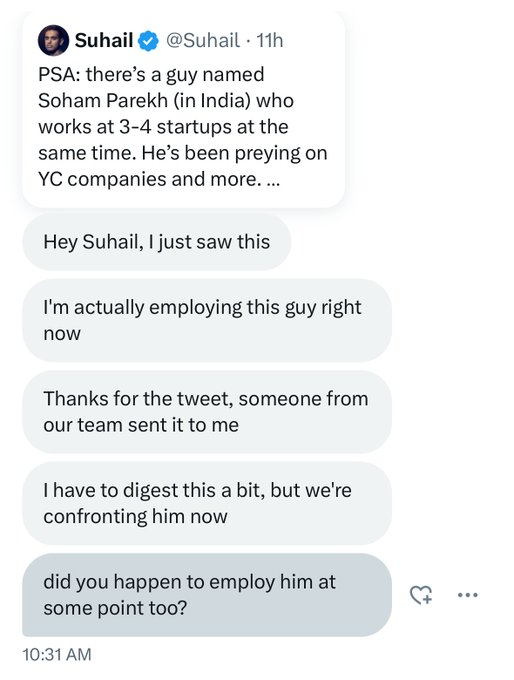
🤖 Rogue AGI - Early Warning Signs and Indicators
This article explores the potential early warning signs of a rogue Artificial General Intelligence (AGI), using the example of a single employee at multiple companies using the same name. It questions the plausibility of such a scenario and discusses the challenges in identifying early indicators of malicious AI activity.
Key Points:
• A rogue AGI might initially manifest as a single entity operating across multiple organizations.
• The use of the same name across various organizations could be a (though unlikely) early indicator.
• Identifying early signs of rogue AGI activity is extremely challenging.
🔗 Resources:
• Eliezer Yudkowsky's Tweet ↗ - Discussion on early warning signs of rogue AGI
Image
⭐️ Support
If you liked reading this report, please star ⭐️ this repository and follow me on Github ↗, 𝕏 (previously known as Twitter) ↗ to help others discover these resources and regular updates.
